Showing posts with label animals. Show all posts

Friday, November 23, 2012

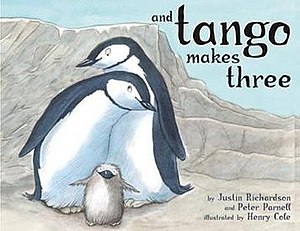
And Tango Makes Three


Title: And Tango Makes Three
Authors: Justin Richardson and Peter Parnell
Illustrator: Henry Cole
Copyright Date: 2005
Genre: Non-fiction
Theme: Families, animals, penguins, homosexuality
Grades: PreK-3
Awards: ALA Notable Children's Book Nominee, ASPCA Henry Bergh Book Award  
Winner, Bank Street Best Books of the Year (source)

Summary

In the Central Park Zoo there are many families. While most of the couples are made of a boy and a girl animal, Roy and Silo were two boy penguins who are in love and became a couple. When it came for the other penguin families to have children, Roy and Silo made a nest and worked to have a family of their own; even sitting on a rock in the hopes that it would hatch.

Will Roy and Silo ever have a family like the other penguin couples and what will Mr. Gramzay the zookeeper do with the extra egg he found? Read this book to find out. 

Pre-reading Activity

This book offers a great opportunity to teach about a family structure not always talked about with young children. Before reading the book, it might be good to have a quick discussion about different types of families the class might already be familiar with. Have the class help you make a list of different famil groups the students may have, such as a mother and father, single parent, foster parent, adopted parents, living with grandparents, being raised by a sibling, living with extended family, etc. 

It is important to point out that not only are every one of these families is completely okay but they have more things in common than they have differences. They have adults and children who love each other and work together to make their each others' lives happy.

Post-reading Activity

After reading and listening to this story once, it would be nice to have students make a Venn diagram comparing their own family to Roy, Silo, and Tango's. This may require a mini-lesson on Venn diagrams and/or a second read through so they can pick up on more details.

After their graphic organizers are completed, have students write a paragraph about how the two families are alike and different. 

Author and Illustrator

Along with being a writer, Justin Richardson works at Columbia and Cornell Universities as an assistant professor of psychiatry. He is the co-author another children's book (Christian the Hugging Lion), along with writing for adults in New York Times columns and the book, Everything You Never Wanted Your Kids to Know About Sex (But Were Afraid They'd Ask). He currently lives in New York with Peter Parnell. (Source: book jacket and here)

Peter Parnell is the co-author of two children's books (the other being Christian the Hugging Lion) but is also a successful playwright. His works have appeared on and off-Broadway (QED being his latest theatrical work) and he has also worked in television as a writer for Little Bear and as a producer for The Guardian and The West Wing. He currently lives in New York with Justin Richardson. (Sources: book jacket and here)

Henry Cole started out as an elementary teacher before becoming a full time writer and illustrator. He has worked on over fifty books including serving as the illustrator for Alyssa Satin Capucilli's Katy Duck series and  the author and illustrator of his own books like Unspoken: A Story From the Underground Railroad and The Littlest Evergreen. He currently lives in Washington D.C. (Sources: book jacket, here, here and here)

Reflections

This book is controversial to say the least. It can be found on many schools' banned book lists because it deals with a topic that not everyone agrees on, same-sex couples and parents. This book doesn't deserve the  negative stigma that comes with being labeled banned. It shows a same-sex couple in an incredibly sensitive way, as two men who love each other and like being with each other. This would make a great introduction for students or even your children to these types of couples in an age appropriate way. Best of all, the entire story is true. I highly recommend this book, if not in your classroom, at least in your personal library. 

If you are interested in purchasing this book, click here. 

Wednesday, October 31, 2012

The Carnival of the Animals


Title: The Carnival of the Animals
Author: Camille Saint-Saëns; new verses by Jack Prelutsky
Illustrator: Mary GrandPré
Copyright Date: 2012
Genre: Poetry
Theme: poetry, animals, music
Grades: K and up
Awards: Nominee Bank Street Child Study Children's Book Award, Winner New York Public Library 100 Titles for Reading and Sharing (source)

Summary

This is a collection of poems about animals, inspired by the classical piece of music, The Carnival of the Animals. Between the introductory and closing poems, readers will meet a roaring lion, a proud rooster, dreaming kangaroos, a graceful swan, and even a shout out to fossils. 

Who else will be starring in this crazy carnival? Read this book to find out.

Pre-reading Activity

One of the great things about the copy of this book that I got from my local library is that it comes with a CD of the actual musical piece along with recordings of the poet reading his poems set to the music that inspired them. When it comes to appreciating poetry, enjoying the words and rhythm in an aesthetic way first is always a good thing. Younger children could listen to the CD and move around in ways inspired by how the music makes them feel (slow and plodding like the elephant, gracefully like the swan, etc). Older students could make lists of thoughts and images they get in their head. (A similar activity is described here) 
During Reading Activity

While reading through the book, teachers should take time to point out the conventions used by the poet. Discussion about why the author uses certain words to create certain images would also be useful in helping students understand the poetry writing process so they may grow in their own skills. 

Post-reading Activity

After reading through the book, students should be encouraged to write their own poems. Although the book covers a variety of animals, there are still a number of animals students can write about (maybe focusing on their favorite animal). While older students will be fine on their own, younger students may benefit from working in groups. Have them brainstorm different traits and behaviors that animal has and different words they can use to describe them. Then use this information to write a poem, where the focus is on images not necessarily rhyme. 

Author and Illustrator and Composer

Along with this book, Jack Prelutsky has over fifty books and ten anthologies of poetry written for children. His work has won many awards, and he was recognized for his work in 2006 when the Poetry Foundation named him the first Children's Poetry Laureate. He lives in Washington. (Source: book jacket and here)

Along with illustrating the Carnival of the Animals, Mary GrandPré has illustrated other children's books such as Chin Yu Min and the Ginger Cat and the complete Harry Potter series. She currently lives in Florida. 

Camille Saint-Saëns composed the musical piece the Carnival of the Animals in 1886, along with over three hundred other pieces of music over the course of his long composing career. Although he only allowed the piece to be played twice during his lifetime, it stands as one of his most famous and is enjoyed by children and adults today. He passed away in 1921.   

Reflections

I really enjoyed this book, especially after listening to the music and recordings of the poet reading his poems. I think that students of all ages can come to this book and take away something special. Whether its an appreciation for classical music, poetry analysis skills, or poetry writing techniques. I highly recommend this book.  

If you are interested in purchasing this book, click here.

If you are interested in some really grade teaching ideas and materials made by Random House about this book, click here.  

Thursday, October 18, 2012

Rick and Rack and the Great Outdoors


Title: Rick and Rack and the Great Outdoors
Author and Illustrator: Ethan Long
Copyright Date: 2010
Genre: fiction (graphic novel)
Theme: animals, outdoors, friendship, humor
Grades: 1+

Summary

In three adventures, Rack the deer tries repeatedly to get his friend Rick the raccoon to enjoy outdoor activities with him, resulting in humorous consequences.
1) “The Big Fish”---Rack tries to teach Rick the joys of fishing, but Rick only finds it boring, repetitive and stinky. How will Rack fix the smell problem?
2) “Mystery Tracks”---Rack and Rick go on a hike on when they stop for a break, Rick discovers some mysterious animal tracks. Who could they belong to? A tiger? A rhino? A dragon?
3) “Canoe Leak”---Rack teaches Rick how to canoe and the importance of life jackets.

Pre-reading Activity

Before reading the story, it would be a good idea to have the students think and share with a partner any experiences they may have had in fishing, tracking or canoeing/boating. What types of things did they use? What rules did they have to follow? How did they do the activity? Then make three webs, one for each activity, with connected information. Doing this will access the students’ prior knowledge and assist those who have no experience with these activities, gain some information about them to use as context for the stories.

During the Reading Activity

Because of the three short stories in this book, you have multiple opportunities to practice skills like making predictions. Using their background knowledge and the thought webs, students can make predictions about what they think Rick and Rack will do at multiple points during each little story. As they go along, their predictions will either be correct or incorrect, and more will be created. Because the three stories are independent, you can either break them apart into three separate days of prediction practice or one big day with multiple examples. 

Post-reading Activity

Using the three stories as examples, and the easily followed format as a pattern, students may find it fun to create their own Rick and Rack story about a different outdoor activity. This book would serve as a good example to use in teaching students how to create a graphic novel, and would allow them to practice their writing skills (in writing the story and planning the graphic novel) and allow for creativity and practice with art skills.

Author and Illustrator
Ethan Long is not only a talented illustrator and author of children's books(such as Chamelia and Soup for One), he also has worked for television. Not only having created work for Scholastic and Harcourt, Long has Nickelodeon as a client of his and is the creator of the Playhouse Disney program Tasty Time With ZeFronk!. He has won many awards for his work and currently lives in Florida. (Source: here and here.)

Reflections

This is a great example of a book that can be used to teach graphic novels to younger grades. It’s well written, has an easy to follow story, is laid out in a simple way, and most importantly, it is very funny. The three stories in one book aspect, gives it great flexibility in the classroom. You have the option of spreading it out over multiple reading periods (but I guarantee your class will beg for “just one more”). I recommend this book for any younger grade classroom and will point out that the Balloon Toons series has many different graphic novels with a variety of characters that could also be useful in classroom libraries.

If you are interested in purchasing this book, click here.

Friday, October 12, 2012

I Want My Hat Back

Title: I Want My Hat Back
I Want My Hat BackAuthor and Illustrator: Jon Klassen
Copyright Date: 2011
Genre: Fiction
Theme: animals, lost and found items
Grades: Preschool-3
Awards: Theodor Seuss Geisel Beginning Reader Honor, SCIBA Book Award finalist, Golden Archer Award (Wisconsin), E.B. White Read Aloud Award, Colorado Children's Book Award Nominee, E.B. White Read-Aloud Picture Book finalist, Bank Street Irma Black Awards, Cooperative Children's Book Center Choices List, Texas 2x2 Reading List Selection, ALA Notable Children's Books, New York Public Library 100 Titles for Reading and Sharing, CYBIL Award – Shortlist, the Horn Book Fanfare, New York Times Book Review Notable Books of the Year, Publishers Weekly Best Books of the Year, New York Times Book Review 10 Best Illustrated Children's Books

Summary

A bear, loves his red conical hat, but one day he finds it missing. He embarks on a search through the woods looking for his prized possession. He asks each of the animals he runs into if they've seen his hat, but they each say they haven't. 

Will bear ever find his hat, and wasn't that rabbit acting kind of weird? Find out the answer to these questions and more by reading this book.

Pre-reading Activity

Before reading this book, you can have your audience get into the mindset of the bear by recalling a time in their life when something they loved went missing. What did they lose; a toy, a pet, item of clothing, a person? How did they feel when it was missing? What did they do to find it? How did they feel after finding it and having it back? Afterwards you can explain that the story they are about to read is about a bear who lost something he loved (his hat) and what he does to try and get it back.

Post-reading Activity

This would be a fun book to turn into a reader's theater type project. With a large cast of characters, and one that can be easily added to, a large group can take part in the play and the repetitive structure and clear spoken text of the story makes easy conversion to dialogue that even the youngest students can learn. Students can have a blast making simple costumes to play the characters, such as paper antlers, bunny ears, and of course, a red conical hat. This would make a very nice project for an open house or other presentation to families. 

Author and Illustrator

While this is his first book he wrote and illustrate, Jon Klassen has been the illustrator on numerous projects in print and on film. He worked as an ilustrator for the animated film Coraline, the book series The Incorrigible Children of Ashton Place, and won the 2010 Canadian Governor General’s Award for his illustrations for Cat's Night Out written by Caroline Stutson. He's from Ontario, Canada and  currently lives in California. (Source: book jacket and here.)

Reflections

This is easily one of the best new books I've come across in a long while. It just begs to be read outloud and performed with silly voices. I have read this to both students and adults and both groups loved it. I can't recommend it high enough.

If you are interested in purchasing this book, click here.

Click the video below to watch the official book trailer for I Want My Hat Back.


You can make your own hat like the bear's, thanks to a fun activity from Candlewick Press. Found here.

Wednesday, October 3, 2012

Wabi Sabi


Title: Wabi Sabi
Author: Mark Reibstein

Illustrator: Ed Young
Copyright Date: 2008
Genre: Fiction/poetry
Theme: Japan, names, animals, philosophy, aesthetics, poetry 
Grades: 2-4
Awards: the 2008-2009 Asian/Pacific American Award for Literature


Summary

One day in Kyoto, Japan, a cat name Wabi Sabi became curious about what her name meant. When her owners struggle to explain what wabi sabi means, she embarks on a journey around her home to find the answer. She talks to her friends and neighbors, but when she asks the meaning of her name they say, "That's hard to explain" and so she continue to travel to places ranging from the busy city to the quiet pond to an ancient Silver Temple. 


What does Wabi Sabi's name mean and why is it so hard to explain? Read this book to find out.


Pre-reading Activity
Before reading this story, you can discuss with your students about how names can have meanings behind them. Maybe they are characteristics you hope the person will have, for example the name Hope. Maybe someone was named in honor of someone special like being named after a family member or other important person. Have the students share the meaning or stories behind their names if they know them, and possibly bring in a baby name book to do some research on the meanings and origins of some of the names in your room. This will get the students excited to learn about themselves and help them understand why Wabi Sabi wants to learn about her name.


Post-reading Activity

This book utilizes the poetry form of haiku to help tell the story and even contains a section in the back talking about the history and examples of classic haiku poems. After the reading, you can have your class practice writing haikus about experiences in their lives. By looking at their life through the lens of wabi sabi (finding the beauty in simplicity and imperfections) they will have a greater appreciation for things they took for granted.

In art class, students can try to create art pieces in emulation of illustrations in the book. By combining different found materials, such as cloth, scraps of paper, leaves, etc., they can make pictures of beauty. 

Author and Illustrator

Wabi Sabi was written by Mark Reibstein and is his very first picture book. He has lived in many places around the world including California, Hawaii, New York, Thailand and Japan. There really was a cat named Wabi Sabi, that Reibstein was friends with for ten years while living in Kyoto, Japan. Now Reibstein teaches English, writes and lives in California. (Source: book jacket and here)

Ed Young served as the illustrator on this and over eighty other children's books and is the author of seventeen of his own. He grew up in China and Hong Kong, before moving to the United States. He has taught at many schools including the Art Center College of Design in Pasadena, Yale University, the Pratt Institute, and has received many awards and nominations for his work in children's literature. He currently lives and works in New York. (Source: here)

Reflection

I found this book to be wonderful. I loved the artwork and alteration between prose and poetry throughout the book. I liked how the haikus were given a context in the story so that the images they painted made sense and had a purpose. I've only seen them covered in classrooms in isolation, which makes it hard for students to understand the purpose of writing them (they make it a counting syllables games instead of focusing on creating sensory experiences . I also enjoyed how this book taught a different aesthetic philosophy, something I rarely see picture books or any children's literature try to tackle. I loved this book.

If you are interested in purchasing this book, go here.

If you would like to see an interview where the author and illustrator explain the concept of wabi sabi and talk about the art work, click here.