Showing posts with label award winner. Show all posts

Saturday, November 24, 2012

King Bidgood's in the Bathtub


Title: King Bidgood's in the Bathtub
Author: Audrey Wood
Illustrator: Don Wood
Copyright Date: 1985
Genre: fiction
Theme: baths, royalty, repeating
Grades: P-2 (source)
Awards: Booklist Starred Review, School Library Journal Starred Review, School Library Journal Best Books of 1985, Caldecott Honor, Pen Los Angeles Center Literary Award, Washington Children's Choice Picture Book Award, Port Washington Children's Favorite Book Award, West Virginia Children's Book Award Honor Book, Colorado Children's Book Award, North Carolina Children's Book Award, Nevada Children's Book Award, ALA Notable Book, Parent's Choice Award, Storytime Featured Book (source)

Summary

King Bidgood is enjoying a bath in his royal bathtub but when it comes time for him to leave it, he won't get out. The Page cries for help and the different members of the court come up with reasons for him to end his bath. Unfortunately  King Bidgood finds a way to have each of their other activities, such as battling and fishing, happen right in his tub with hilarious consequences. 

What or who will finally get King Bidgood out of the tub? Read this book to find out.

Pre-reading Activity

The humor of this book relies on readers understanding the ridiculousness of fishing, eating, and dancing in the tub. Have a discussion about baths before reading this book, possibly making two lists. The first would be what they do in the bathtub---wash our hair, play with rubber ducks, have bubbles, etc. The other would be things that they don't (or shouldn't) do in the bathtub---ride a bike, cook, play videogames, etc. After the two lists are done, explain that you are going to be reading a book about a very silly king who does some very strange things in the bathtub.

During Reading Activity

This book is written in a repetitive and wonderfully predictable way. Have the students predict what they think will happen to the Queen and the Duke, after seeing how King Bidgood waged battle in the tub earlier. Students may also enjoy reading along with the teacher, especially if you read this book more than once.

Post-reading Activity

Due to its repetitive style and large cast of characters, this book is a favorite to turn into a reader's theater. You can assign parts to students and have them read the words and perform the actions from their parts of the book, acting in front of an audience of classmates, another class, or even parents. 

These two videos show different classes performing their versions of the book in play form, utilyzing the audio recording of the book available here


Author and Illustrator

Audrey Wood is not only an author, but also an artist (the fourth generation of artists in her family), has owned and ran a book and import store, taught drama, even traveled throughout South America. Along with writing this book, she has written and illustrated her own books (like Blue Sky), and written others that have been illustrated by her husband Don (like Heckedy Pig) and her son Bruce (like Alphabet Rescue). She currently lives in California. (Sources: book jacket, here, and here)   

Don Wood provided the wonderful illustrations for this book that won it the prestigious Caldecott Medal. Along with illustrating this book, he has illustrated many books by his wife Audrey, (such as Piggies). He is also an author himself, writing books with his wife (such as The Big Hungry Bear) and even one by himself (Into the Volcano). He currently lives in California. (Sources: book jacket, here, and here)

Reflections

This is one of my favorite books from my childhood and it really holds up years later. Your class will love the  sing song nature of the book and and being able to "read" along with the teacher. No doubt you will also find students pouring over the illustrations, looking at the great details and funny things hidden in them. I can almost guarantee that this will become a favorite in your classroom. I highly recommend it.

If you are interested in purchasing this book, click here

Saturday, November 10, 2012

That Book Woman


Title: That Book Woman
Author: Heather Henson
Illustrator: David Small
Copyright Date: 2008
Genre: Historical Fiction
Theme: Appalachia, history, Social Studies, reading, librarians, school
Grades: 2-5
Awards: Anne Izard Storytellers' Choice Award (NY), Beehive Award Master List (UT), CBC/NCSS Notable Social Studies Trade Book, Christopher Award, Golden Sower Masterlist (NE), Great Lakes Book Award, Kentucky Bluegrass Award Master List, Keystone to Reading Book Award (PA), Parents' Choice Award, Storytelling World Award, Storytelling World Award Honor Book, "Stories for Young Listeners, Texas Bluebonnet Master List (Source)

Summary

Cal, his Pap, Mama, sister Lark, and the rest of his family live on their farm high up in the Appalachian Mountains, away from schools, towns and other people. Lark always seems to have her head in a book, but Cal feels that since he knows how to help run the farm, there isn't a need for "dumb old books." One day a visitor, a woman wearing pants, arrives on horseback to give Cal's family some books for free. Not only does she visit once, but she returns again and again to exchange those books for new ones.

What will the Book Woman do when winter hits the mountain? Will Cal's disapproval of reading ever change? Read this book to find out.

Pre-reading Activity

Before reading the story, it would help to get students to understand the educational situation Cal's family and other families living in the Appalachian Mountains during the Great Depression. Start by talking to the class and asking how far away they live from the school. Some will live in close walking distance and some need a car or bus ride. Ask them how easy it would be to get to school if they had to walk because cars would be much too expensive to own and there weren't any school buses. Then how hard it would be if they had to walk miles to and from school? Then what if that distance included going up and down a mountain? Then what about during blizzards?  Would you be able to do that and still work a full day of work on a farm? Explain that during the Great Depression, children living in the Appalachian Mountains of Kentucky were put in this exact situation. Because of all of these challenges, many children never went to school, and so they learned things like reading in a different way.

During Reading Activity

This book is a great one for tracking changes in characters throughout the story. Classes could take notes on Cal's feelings toward reading at the beginning, middle, and end of the story, as an example of character evolution. 

Post-reading Activity

After the story has been read, students can make connections to their own life by writing a response, with a prompt such as "Has there ever been a time in your life when you changed your opinion about something you disliked like Cal did? What caused you to change your mind?." It also may be good for students to write a comparison piece, describing how they learned to read (in an organized school, with a building, teachers, etc.) and how Cal and other Appalachian students during that time period (at home, teaching themselves and each other with materials provided by the Pack Horse Librarians). 

Author and Illustrator

Heather Henson worked at HarperCollins Publishers in Brooklyn for years editing other people's books before returning home to Kentucky to write her own. Along with That Book Woman, she has written five other books, including Grumpy Grandpa and Making the Run. She currently lives in Kentucky. (Source: book jacket and here)

David Small has won numerous awards for his work illustrating over forty children's books including the Caldecott Medal for his work on So You Want to Be President?. Not only does he illustrate other authors' books, but also is an author himself, including being the author and illustrator of the classic book, Imogene's Antlers. He currently lives in Michigan. (Source: book jacket and here)

Reflections

I am sadly unknowledgeable about the history and culture of those living in Appalachia, and so I found this book no only enjoyable but also educational for me. I learned a lot about this often overlooked part of history and the country, and I'm sure students of all grades would take away something new as well. I loved how it was written with the dialect of the region represented and respected and of course the art is fantastic. I highly recommend it.

If you are interested in purchasing this book, click here.

Thursday, November 8, 2012

I Lay My Stitches Down


Title: I Lay My Stitches Down: Poems of American Slavery
Author: Cynthia Grady
Illustrator: Michelle Wood
Copyright Date: 2012
Genre: Poetry
Theme: Poetry, non-fiction, Social Studies, African-American, slavery, biography, history
Grades: 5 and up
Awards: Parent's Choice Silver Honor (source)

Summary

This book is a beautifully written and illustrated collection of poems about the experiences of those living as slaves in America. The poems cover topics such as working in the home and fields, punishment, secretly educating themselves, and their escape through the Underground Railroad among others. These poems are backed up with great quilt inspired illustrations and sections of historical context to help explain the poems.

What was life like for the African-Americans living in slavery? Read this book to find out.

Pre-reading Activity

Because this book covers so many different aspects of life as a slave, it lends itself well to a KWL chart. Before reading the book have the students share everything they know about slavery and record it in the first column of a three columned chart. This will be the "what I already Know" column. Record everything, even if it is a misconception. All of this is their background knowledge of the subject. Next, in the second column, write down all the questions they might have about slavery. This is the "What I want to know" column. Any question about slavery will work here. This is the information they will be looking for during the story. 

During Reading Activity

While reading the story, if an answer to a question comes up, write a note next to the question in the third column of the chart. This is the "What I learned" column. This is also a good place to write some information that may contradict some of the misconceptions students may have had before too.

Post-reading Activity

After reading through the book, and finishing the chart of all the new information and greater understanding they have about slavery, this would be a great time for students to do some writing. Since the KWL chart contains the notes from the book, students can use the information to write a paragraph about life in slavery. For older students, you could bring in more texts and have them synthesize them into a true research paper.   

Author and Illustrator

Cynthia Grady works as a middle school librarian when she isn't writing or making quilts. This book is her very first book to be published. She currently lives in Washington DC. (Source: book jacket and here)

Michelle Wood is an award winning artist, earning the American Book Award for the first book she illustrated, Going Back Home. Since then she has earned other awards, including the Coretta Scott King Award and her work has received lots of praise from critics. She currently lives in Indiana. (Source: book jacket and here)

Reflections

I'm a big fan of this book. Not only are the poems meaning AND accessible, but the illustrations just makes everything come alive. This is a great way to introduce this difficult part of American history to young students, especially with the contextual paragraphs on each page. A very good book.

If you are interested in purchasing this book, click here.

Thursday, October 18, 2012

Desk Stories


Title: Desk Stories
Author and Illustrator: Kevin O’Malley
Copyright Date: 2011
Genre: fiction (graphic novel)
Theme: desks, school, humor
Grades: 2-4
Awards: 2012 IRA-CBC Children's Choices

Summary

This book is made up of six separate stories, all about a different take on the school desk:

1). “History Man”---a humorous history of desks through the caveman times, the Middle Ages and today. What type of desks did they use in the past?
2). “Trapped!”---John, a very bored student finds himself being chased and then trapped by his desk. Will he be alright?
3). “It Came From Within”---Sara, a “perfect student” is good at everything in school and isn't afraid to rub it in. One day she feels something warm and furry in her desk and learns a very important lesson in humility. What was the thing living in her desk?
4). “Desk Time Jokes”---A collection of classic school themed jokes.
5). “Desktec”---Readers get unprecedented access to the secret plans of Desktec about new desk technology. What will the desk of the future be like?
6). “Sue Smallton: The Incredible Shrinking Supergirl”---Sue, our super-heroine must shrink down and explore her desk to return a barrette.  What dangers will she encounter?

Pre-reading Activity

It could be fun to have students have a guided thinking session. Have them think about their desks in ways they may not have thought before. Think about all of the things they do at it; work, read, play, draw, eat, etc. How important is it to you? What if your desk could talk. What do you think would it say? What would it do if it could move? Have them share a few answers for each question. Then explain that the book you are going to read looks at desks in an imaginative way and that it can be fun to think about things in different ways.

Post-reading Activity

After the book, students can have a chance to write their own creative stories, taking an ordinary object and looking at it in a different way. They can pick an object (book, a food, classroom pet, etc.) and then use prompts inspired by the stories:

What would happen if the subject were alive/could talk?
What would that object be like in the future?
What if you could shrink down and go inside/hang out with your object? What would happen?

This would students to be able to write a story that can be funny and of interest to them and they will probably would like to share it. (I later found that the publisher's website has a review of this book that also suggests using it as a model for creative writing. It's entirely a coincidence but I'll link their page here.)

Author and Illustrator

Along with Desk Stories, Kevin O'Malley has written and illustrated the similar style book, Backpack Stories, and worked a plethora of other books such as Slugs in Love, Humpty Dumpty Egg-splodes, and the Miss Malarky book series. He currently lives in Maryland. (Source: book jacket, here, and here.

Reflections

This is a fun book with a variety of story styles to attract readers. These stories are short enough that a few could be shared during a story time, while also able to fill a lesson's worth of discussion in themselves. This can allow teachers to fill a whole week of read-alouds without changing books. This would definitely grab the attention of reluctant readers.

If you are interested in purchasing this book, click here.


Luke on the Loose


Title: Luke on the Loose
Author and Illustrator: Harry Bliss
Copyright Date: 2009
Genre: fiction (graphic novel)
Theme: city, children
Grades: K-2
Awards: Junior Library Guild Selection

Summary

A young boy named Luke went for a walk with his father in Central Park. When he notices a group of pigeons, he begins chasing after them, traveling across the city and causing all kinds of problems. Because of his running loose there is a traffic jam, dropped ice cream, and even an interrupted marriage proposal.

Where will the pigeons bring Luke to next and when will he ever stop chasing them? Read this book to find out.

Pre-reading Activity

You can tap students background knowledge on what a city is like and what they may find there, in order to help them to be better able to understand the setting of the story and identify the people, actions and objects found in the illustrations.

Post-reading Activity

In this book, there is little text, other than the dialogue and sound effects. It might be fun to try and use the illustrations in the book in order to create a picture book version of the story. This would involve students writing narration of the pictures to describe what is shown only through illustration in this format. This would help them practice proper sentence creation and sequencing without having to think of their own topics since they have the story already available to them as a scaffold. The list of city things from the pre-reading activity might serve as a useful word wall for their writing.

Author and Illustrator

Luke on the Loose is Harry Bliss’s very first graphic novel, but not his first as a cartoonist or illustrator. He has worked with award winner authors on books such as Which Would You Rather Be? and Louise, the Adventures of a Chicken, and works on the New Yorker as a cover artist and cartoonist. He currently lives in Vermont. (Source: about the author page)

Reflections

Besides being a really fun, this book is a great example to use when introducing graphic novels to students. Teachers can easily show how to approach and read a graphic novel while not worrying about difficult formatting or overly complicated stories. Students learning English would also love this book as well, being able to use the pictures as context for the words, or to still understand the story if the words prove too difficult. I highly recommend this book for those introducing the graphic novel format.

If you are interested in purchasing this book, click here.

The book's publishing company, Toon Books, has a great lesson plan using a Reader's Theater about this book, available here. 

Friday, October 12, 2012

Keeper of the Soles


Title: Keeper of the Soles
Author: Teresa Bateman
Illustrator: Yayo
Copyright Date: 2006
Genre: Fiction
Theme: Shoes, Death, Cheating Death
Grades: 2-4
Awards: Horn Books Fanfare List - Best Books of 2006

Summary

Colin, a talented and well-loved shoemaker, helps put wonderful shoes on the feet of the rich and poor alike. One dark night, Death knocks on Colin’s door. He has come from Colin’s soul. Looking at Death’s bare feet, Colin comes up with a clever plan to save himself.

What plan does Colin come up with and is he successful in saving his soul? Read this book to find out.

Pre-reading Activity

Before reading this book with younger students, teachers can access students background information about shoes. Teachers can ask for students to think of as many different types of shoes they can name. There are many different answers they may give such as boots, sneakers, sandals  flip flops, high heels, platform, clown, bowling, etc. With this list, teachers can explain how some shoes are better at some times and silly during others (Snow shoes are really useful in the snow, but silly during good weather). Then explain how in the story they will be learning about a cobbler (someone who makes shoes) who makes a variety of shoes for a very special customer, for many different purposes.

With an older group of students, teachers could have a short lesson on traditional story archetypes. This would involve talking about how multiple cultures may tell stories differently but there are some categories that many different stories can fall into. For example each culture tends to have their take on creation stories, folk tales, heroic quest, etc. One example of a traditional story pattern present in many cultures is the story of someone cheating death. Examples like the story of Sisyphus from Greek mythology, the man who caught Death in a sack (from "Godfather Death" from the Brother's Grimm), the image of playing chess with Death, and even cartoons like The Grim Adventures of Billy and Mandy (where not only do the heroes trick the Grim Reaper out of getting souls but also force him to become their best friend forever). This story is another example of this type of story (and even references the chess with Death story on the cover).

Post-reading Activity

In the title of the story there is a joke made about the homophones soul and sole, both of which have importance in the story. Teachers of younger students can use this as a place to teach a lesson about these potentially confusing types of words. The teacher can create sentences with blanks where two related homophones would go and have students determine which spelling of the word would go where. Like in the following examples:

Death came to Colin’s home to take his _____ and walked out with new boot with a leather _____. (soul/sole)
Susan was wondering _____ that dress she wanted to _____ to school today. (where/wear)

Older students may find it fun to test their creativity by creating their own outwitting death story. What different ways can they think of tricking the Grim Reaper?

Author and Illustrator

Along with writing, Teresa Bateman also works as a storyteller and school librarian. She has written twenty books, including Red, White, Blue, and Uncle Who?: The Story Behind Some of America's Patriotic Symbols and Fluffy: Scourge of the Sea. She currently lives in Washington State. (Source: book jacket and here.)

Yayo, also known as Diego Herrera, is a renowned cartoonist originally from Columbia. His artwork has been published in the United States in newspapers, books, and magazines, and has had exhibitions in Brazil, Russia, Canada, Japan and Turkey. This children's book was the first one he illustrated. He currently lives in Montreal. (Source: Book Jacket and here.)

Reflections

I found this book to be a fun story that kids would enjoy. Its pattern of Colin thinking of a new type of shoe each time Death came to the door, allows students make predictions of what kind he will try next and its nice ending of befriending Death will leave readers smiling. I think this book deserves a place in your library.

If you are interested in purchasing this book, click here.

Wednesday, October 3, 2012

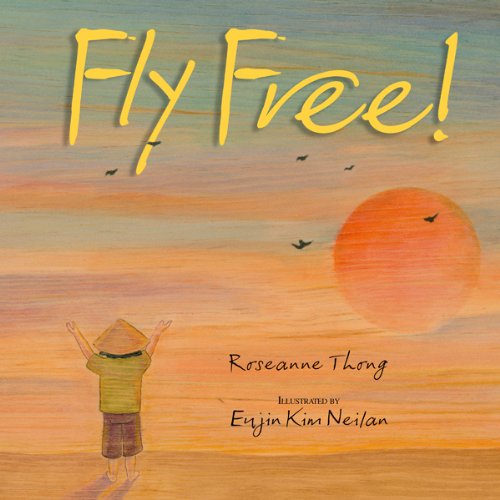
Fly Free!

Title: Fly Free!
Author: Roseanne Thong
Illustrator: Enjin Kim Neilan
Copyright Date: 2010
Genre: Fiction
Theme: Vietnam, karma, kindness, cause and effect
Grades: Preschool-3
Awards: 2010-2011 Asian/Pacific American Award for Literature Honor, 2011 Bank Street College, The Best Children's Books of the Year (Age 5-9), The Society of School Librarians International 2010 Honor Book Award in "Language Arts - Picture Books," 2011 Maryland Black-Eyed Susan Book Award Nominee, 2011-12 Maine Chickadee Award Nomination, 2012 NYSRA Charlotte Award Nomination, 2011 Notable Books for Global Society List

Summary

Mai, a young girl living in Vietnam, loves the caged sparrows that live outside of the Buddhist temple. She loved feeding them and wished that one day she could let them free. One day, Mai helps her friend Thu feed the birds, and whispers the rhyme:

"Fly free, fly free,
in the sky so blue.
When you do a good deed,
it will come back to you."

Little does Mai know, but she had kicked off a series of good deeds that would spread far and wide around her home.

Where will her good deed lead to and how will karma come back to Mai? Read this book to find out.

Pre-reading Activity

You can help set the stage for his book, by having your students think and share what good deeds they have done for others or had done to them. Have them explore their feelings and the other person's before and after the good deed. Emphasize that doing good things and helping others makes both people happier. Then tell the class, that you will be reading about a young person, just like them who likes to make other people happy by doing good things.

Post-reading Activity

You can follow up this story by doing an activity that emphasizes the cause and effect theme. Students might write a group story, one part at a time. The teacher may start off by explaining a good deed she does for one student. That student then explains how it made him feel and what good thing they do for another student. Then that student picks up the story and the process continues until the last student ends up doing something nice for the teacher. This can all be done orally with the teacher writing it down on a big sheet of paper. Students can also get practice writing and illustrating, by creating a page with their section of the story and the teacher can bind all the students pages to create a class book.

Author and Illustrator

Roseanne Thong wrote Fly Free! after learning about Vietnamese culture through years of teaching Vietnamese student both in California and in Vietnam itself. She has taught English in places around the world too, including Burma, Cambodia, Vietnam, Guatemala, Hong Kong and the USA. Thong has written many books, including Red Is a Dragon, Round is a Moon Cake, and Ten Friendly Fire Flies. She currently lives in California. (Source: book jacket and here)

Enjin Kim Neilan is illustrator of Fly Free! and four other children's books. She grew up and studied art in Seoul, South Korea, used the illustrations for her first children's book, In the Moonlight Mist: A Korean Folktale, as her Master's thesis. She uses diverse methods to create her art, such as the painting on wood used in this book. She currently lives in Massachusetts. (Source: book jacket and here)

Reflections

I really enjoyed the message of this book, that while rewards for good deeds may not be immediate or what we expect, they will eventually find their way back to us. This book could easily fit into units about character development, multicultural studies, or even just as an example of cause and effect. It is a book I recommend.

If you are interested in purchasing this book, click here.


Wabi Sabi


Title: Wabi Sabi
Author: Mark Reibstein

Illustrator: Ed Young
Copyright Date: 2008
Genre: Fiction/poetry
Theme: Japan, names, animals, philosophy, aesthetics, poetry 
Grades: 2-4
Awards: the 2008-2009 Asian/Pacific American Award for Literature


Summary

One day in Kyoto, Japan, a cat name Wabi Sabi became curious about what her name meant. When her owners struggle to explain what wabi sabi means, she embarks on a journey around her home to find the answer. She talks to her friends and neighbors, but when she asks the meaning of her name they say, "That's hard to explain" and so she continue to travel to places ranging from the busy city to the quiet pond to an ancient Silver Temple. 


What does Wabi Sabi's name mean and why is it so hard to explain? Read this book to find out.


Pre-reading Activity
Before reading this story, you can discuss with your students about how names can have meanings behind them. Maybe they are characteristics you hope the person will have, for example the name Hope. Maybe someone was named in honor of someone special like being named after a family member or other important person. Have the students share the meaning or stories behind their names if they know them, and possibly bring in a baby name book to do some research on the meanings and origins of some of the names in your room. This will get the students excited to learn about themselves and help them understand why Wabi Sabi wants to learn about her name.


Post-reading Activity

This book utilizes the poetry form of haiku to help tell the story and even contains a section in the back talking about the history and examples of classic haiku poems. After the reading, you can have your class practice writing haikus about experiences in their lives. By looking at their life through the lens of wabi sabi (finding the beauty in simplicity and imperfections) they will have a greater appreciation for things they took for granted.

In art class, students can try to create art pieces in emulation of illustrations in the book. By combining different found materials, such as cloth, scraps of paper, leaves, etc., they can make pictures of beauty. 

Author and Illustrator

Wabi Sabi was written by Mark Reibstein and is his very first picture book. He has lived in many places around the world including California, Hawaii, New York, Thailand and Japan. There really was a cat named Wabi Sabi, that Reibstein was friends with for ten years while living in Kyoto, Japan. Now Reibstein teaches English, writes and lives in California. (Source: book jacket and here)

Ed Young served as the illustrator on this and over eighty other children's books and is the author of seventeen of his own. He grew up in China and Hong Kong, before moving to the United States. He has taught at many schools including the Art Center College of Design in Pasadena, Yale University, the Pratt Institute, and has received many awards and nominations for his work in children's literature. He currently lives and works in New York. (Source: here)

Reflection

I found this book to be wonderful. I loved the artwork and alteration between prose and poetry throughout the book. I liked how the haikus were given a context in the story so that the images they painted made sense and had a purpose. I've only seen them covered in classrooms in isolation, which makes it hard for students to understand the purpose of writing them (they make it a counting syllables games instead of focusing on creating sensory experiences . I also enjoyed how this book taught a different aesthetic philosophy, something I rarely see picture books or any children's literature try to tackle. I loved this book.

If you are interested in purchasing this book, go here.

If you would like to see an interview where the author and illustrator explain the concept of wabi sabi and talk about the art work, click here.

Wednesday, September 26, 2012

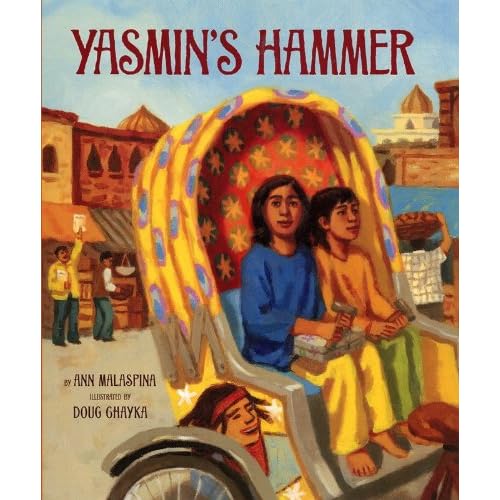
Yasmin's Hammer


Title: Yasmin's Hammer
Author: Ann Malaspina  
Illustrator: Doug Chayka
Copyright Date: 2010

Genre: Fiction
Theme: child labor, education, Bangladesh 
Grades: 3-4
Awards: the 2010-2011 Asian/Pacific American Award for Literature,  Horace Mann Upstanders Children's Literature Award, Honor Book, Best Children's Books of the Year by Bank Street College of Education, Notable Children's Books by Smithsonian Magazine 


Summary

Once living near a paddy field in Bangladesh, Yasmin and her family move to the city of Dhaka after a cyclone destroys their home. In order to pay for their home there her Abba (father) must run a rickshaw, her Amma (mother) cleans in a wealthy home, and Yasmin and her sister Mita work breaking bricks for concrete. Yasmin has dreams of going to school, but whenever she tells her parents they say, "Not yet." One day she starts receiving tips from her boss for her hard work and she saves her money under her bed.

What is she going to purchase with her secret stash of money and will her family be able to help her live her dream of going to school? Read this book to find out.

Pre-reading Activity


Before reading this story, it might be a good idea to give your class a bit of background on Bangladesh. Locating Bangladesh on a map or globe and showing how far away it is and the geographic features of the area will help students place Yasmin and her family into their view of the world. 
Because this story deals with child labor, it might also be a good idea to give your class a bit of an age appropriate introduction to this idea. This can be as simple as explaining that in some places of the world, families may be so poor that they need their children to get jobs in order to help pay for things instead of letting them go to school. You might want the class to share with a partner how they would feel if they had to go do hard work everyday instead of coming to school. Would they be more or less happy?  

Post-reading Activity

After reading this story, students can take some time to compare their lives to those experienced by children in Bangladesh. They can complete a Venn Diagram comparing life in their town to Yasmin's life in Dhaka including discussing the types of jobs, language, transportation and opportunities for children. They could then use this graphic organizer to make a writing piece discussing the similarities and differences between their life and Yasmin's. 
This book also provides an Afterword and links to websites that discuss Bangladesh and the countries efforts to end child labor in that country. With teacher guiadance, students may investigate further into the cause and plan an awareness campaign or fundraiser in their school to help out children like them in other countries have the opportunity to get an education.
Author and Illustrator

Yasmin's Hammer was written by Ann Malaspina. She is the many historical and mulitcultural books including Phillis Sings Out Freedom and Heart on Fire: Susan B. Anthony Votes for President. After visiting Southern Asia and seeing the children first hand and learning more about the plight of brick chippers in the news, Malaspina was inspired to write a book about the over 200 million children who going to school was just a dream. She currently lives in New Jersey. (Source: book jacket and here.
)
Doug Chayka was the illustrator for Yasmin's Hammer. He works as a freelance artist for clients such as   Eerdmans Books for Young Readers, Henry Holt Books for Young Readers, and Houghton Mifflin. He has illustrated five other children's books, including Yanni Rubbish and The Secret Shofar of Barcelona. He currently lives in Florida. (Source: book jacket and here.)
Reflection

This book is a safe and interesting way to introduce a tough reality (child labor) to younger students and provide opportunities for them to begin learning about and trying to solve some of the world's problems. It is a great book about hope for a better life, even when things are tough. I highly recommend it.

If you are interested in purchasing this book, click here.
Cora Cooks Pancit

Title: Cora Cooks Pancit
Author: Dorina K. Lazo Gilmore
Illustrator: Kristi Valiant
Copyright date: 2009
Genre: Fiction
Theme: cooking, family
Grades: K and up
Awards: the 2009-2010 Asian/Pacific American Award for Literature

Summary

Cora is the youngest child in her Filipino American family. She loves being in the kitchen watching her mother create the foods her grandfather (Lolo) taught her to make. However, whenever she tries to help, her older siblings get to do all of the "grown-up jobs." One day her siblings are all busy and Cora gets her chance to be her mother's assistant in making a dinner of pancit for her family.

How did she do with all of her "grown-up jobs" and did the family like the pancit? Read this book to find out along with a recipe so you can cook along with Cora.

Pre-reading Activity

You can help your students access their prior knowledge of the feelings Cora is having by asking them to think about a time in their life where they wanted to do something but were too little. Maybe they wanted to use tools to help fix something, get to go on a big kid ride at an amusement park, or have the responsibility of owning a pet. How did they feel while they were told they were still too young to do these things and how did they feel when they finally were allowed to?

Post-reading Activity

Students can connect their lives with Cora's by thinking about a special food their family likes to eat together. They can then write a short piece on the ingredients and steps need to cook this meal. Teachers can evaluate these recipe stories for clarity, sequence, and organization.

It could also be a really neat thing if the teacher were to collect these recipes and create a class cookbook that can be printed for every students' family to use at home.

Author and Illustrator

Cora Cooks Pancit was written by Dorina K. Lazo Gilmore. Gilmore is a big fan of cooking, particularly foods she grew up with in her Filipino-Italian family. She's wanted to write children's books since she was a child. Believing that "children need to see themselves in books," she has focused on writing books with multicultural protagonists and families, including Children of the San Joaquin Valley and Stone Soup: A Hmong Girl's Journey to the United States. She currently lives in California. (Source: book jacket and here.)

Kristi Valiant made her illustrating debut on Cora Cooks Pancit. Valiant was the magnum cum laude of her  class from the Columbus College of Art and Design before working for an educational publisher and then illustrating children's books. She has recently published her first children's book as an author and illustrator, Penguin Cha-Cha. She currently lives in Indiana. (Source: book jacket and here.)

Reflection

I really enjoyed this book. Cora is a girl that I feel most children could relate to; frustrated with being too little, overjoyed when she can help, nervous about whether her work is good enough. Although the smells and tastes weren't there, the illustrations brought the food and cooking to life, and have put pancit on the short list of foods I'm going to try making at home. Great book.

If you are interested in purchasing this book, click here.